Showing posts with label knitting pattern. Show all posts

Sunday, February 7, 2021

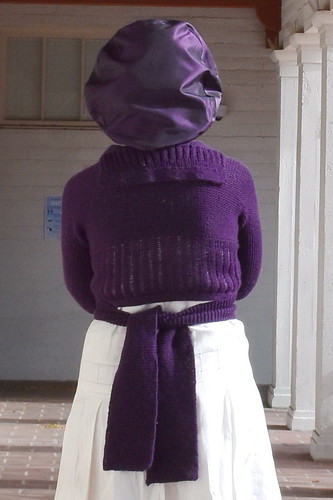
Making the 1920s "Two Day" Sweater

20s Sweater 2 20s Sweater 3 20s Sweater 4


An ad for a sweater using Fleisher Yarns, The Diane Sweater was published in The Ladies’ Home Journal in April 1921. The sweater calls for Shetland Floss, which is about a modern fingering weight. Based on similar patterns, the gauge is five stitches an inch--this isn’t what you expect from fingering weight, but I achieved it with size 8 needles when I was figuring out another pattern. I made my sweater with sport weight yarn on size 6 needles, which also gives 5 stitches an inch. The fit of the sweater counts on the stretchiness of the finished sweater--no size is given.

The sweater is knit in one T shaped piece, starting at the back with added cuffs, collar, and belt. It’s folded at the shoulder, the side seams are sewn, and the belt is sewn to the bottom front edge and tied in back. My notes and changes to the pattern are in brackets. [ ]

This post is just about construction--more pictures and details can be found on this post. I've included a copy of the pattern without pictures at the end of this post, and a PDF is available here.

Thursday, December 25, 2014

A Knitted Muff from 1847

DSC_9815a

I'm going through a little bit of a knitting phase right now (active projects--an 1857 Princess Royal's Scarf, a cobweb weight nubia (giant scarf thing) on size three needles, an 1860s Mariposa Hood), and as I often do while in knitting phases, I read period knitting patterns. How Dumbledore of me. Anyway, I came across The Child's Muff of Two Colors in The lady's assistant, for executing useful and fancy designs in knitting, netting, and crochet work. by Jane Gaugain and was intrigued. The pattern was interesting--the look of netting over a ground, the technique was interesting--knitting two colors after another instead of back and forth, and just why is it a child's muff? It's the same size as the muff in imitation of black Siberian lamb's-skin on the page before. That one is just ribbed and we all know ribbing looks just like lamb's skin, right?

The pattern is surprisingly simple. It's a four row repeat. I've included a picture of the pattern at the bottom of the post, but I rewrote it so it was a little easier to follow. I used Cascade Aran weight yarn for the 9 ply fleecy in the pattern, and size 8 needles. The pattern calls for a modern size 7, but I have a 6 and an 8. Size 6 was too small, but the size 8 worked nicely. I also increased the number of stitches cast on from 35 to 47. It needs a repeat of three plus two for the selvages. This PDF--Everyone His Own Knitting Needles by Colleen Formby--at raggedsoldier.com is a great source for figuring out period to modern equivalents.

A link to my Ravelry page for the muff, though this post is more detailed.

Instructions below the cut! I've included a very detailed and a straightforward version.

Thursday, May 9, 2013

A Knitted Star Bag

The Lady's Assistant for Executing Useful and Fancy Designs in Knitting, Netting, and Crochet Work (1847) by Jane Gaugain is an incredible book. Not only does it have a pattern for the rather famous pineapple (I've knit one! Blog post eventually!), but it has many clear, easy to understand, followable patterns! Amazing for Victorian knitting. One that I found particularly intriguing was the Knit Bag of Purse Twist and Steel Beads. So, I made it, and even though the pattern was clear, made a chart and wrote the directions out more fully, complete with charts and row by row instructions.

star bag 14 star bag 13

Knitted and crocheted bags with star motifs at their bottoms were popular during the Victorian era. And why not? Not only are these stars attractive, but they’re one of those deceptively simple things to knit. Once you get past the probably most awkward knitting ever—casting on eight stitches over four double pointed needles—it’s incredibly logical and the design progresses quickly. Don’t be intimidated by the 5/0 needles. They’re remarkably quick to adjust to. They’re quite the conversation piece as well—who doesn’t occasionally like impressing others with knitting?

star bag 1 star bag 11

Adjustments to original: Mrs. Gaugain’s original pattern was remarkably clear. The only adjustment I’ve made to it is to add a row of eyelets near the top to thread a drawstring though. She makes no mention of how the bag should be finished. Contemporary bags in museums often have a row of eyelets, so I decided to include them. My bag—like many originals—is lined. I used a tube of silk taffeta, gathered at the bottom and whipstiched into place just below the eyelets.

star bag 8 star bag 6

Here's a link to my Ravelry project page.
And here's a link to the pattern page on Ravelry.

The pattern is below the cut!

I'm also going to include a PDF of the pattern. I can't do it on my almost seven year old computer though, and will post it once I can do it at work :)

And a PDF of the pattern! I downloaded an app for my phone--I'm surprised I didn't think of that first!